Cbio Breaking Out Again With Steadier Volume
10.7: Homeostasis and Feedback
- Folio ID
- 17075
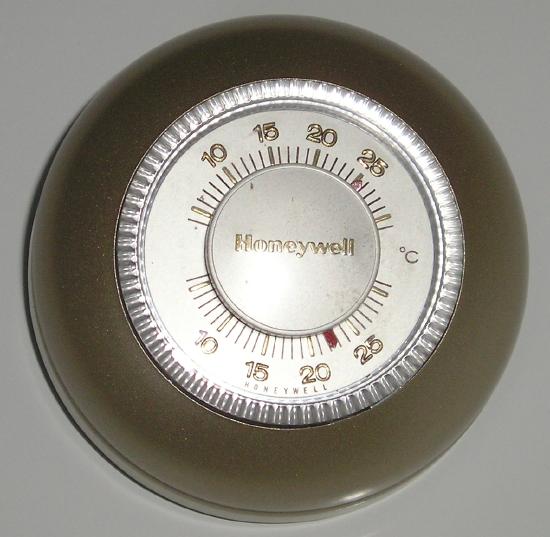
This device looks simple, only information technology controls a complex arrangement that keeps a habitation at a steady temperature. The device is an old-fashioned thermostat. The dial shows the electric current temperature in the room and also allows the occupant to fix the thermostat to the desired temperature. A thermostat is a normally cited model of how living systems, including the human body, maintain a steady state called homeostasis.
What is Homeostasis?
Homeostasis is the condition in which a system such as the human being body is maintained in a more-or-less steady land. It is the task of cells, tissues, organs, and organ systems throughout the body to maintain many different variables within narrow ranges that are compatible with life. Keeping a stable internal environment requires continuous monitoring of the internal environs and constantly making adjustments to keep things in balance.
Setpoint and Normal Range
For any given variable, such as trunk temperature or blood glucose level, at that place is a particular setpoint that is the physiological optimum value. For case, the setpoint for human body temperature is about 37 ºC (98.6 ºF). Every bit the body works to maintain homeostasis for temperature or any other internal variable, the value typically fluctuates around the set indicate. Such fluctuations are normal equally long as they do not become as well extreme. The spread of values within which such fluctuations are considered insignificant is called the normal range. In the case of body temperature, for example, the normal range for an developed is near 36.five to 37.v ºC (97.7 to 99.5 ºF).
Maintaining Homeostasis
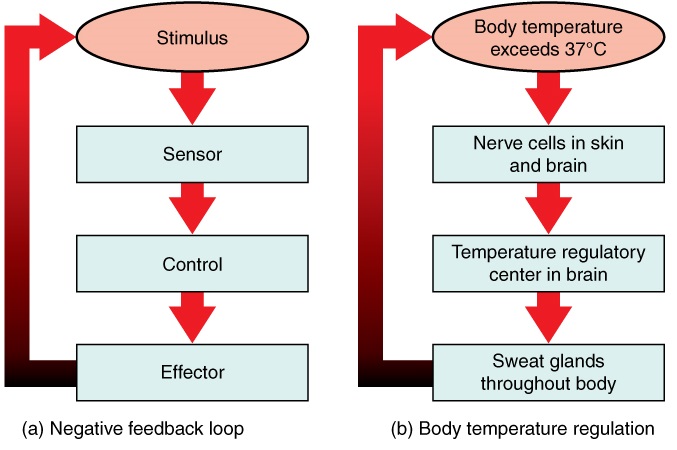
Homeostasis is normally maintained in the human torso by an extremely complex balancing act. Regardless of the variable being kept inside its normal range, maintaining homeostasis requires at least iv interacting components: stimulus, sensor, control center, and effector.
- The stimulus is provided by the variable that is existence regulated. Generally, the stimulus indicates that the value of the variable has moved away from the set signal or has left the normal range.
- The sensor monitors the values of the variable and sends data on it to the control middle.
- The control middle matches the data with normal values. If the value is not at the fix bespeak or is outside the normal range, the control center sends a indicate to the effector.
- The effector is an organ, gland, muscle, or other construction that acts on the point from the control center to move the variable back toward the ready point.
Each of these components is illustrated in Figure \(\PageIndex{2}\). The diagram on the left is a general model showing how the components collaborate to maintain homeostasis. The stimulus activates the sensor. The sensor activates the control organisation that regulates the effector. The diagram on the right shows the example of torso temperature. From the diagrams, yous tin can come across that maintaining homeostasis involves feedback, which is data that feeds back to control a response. Loftier body temperature may stimulate the temperature regulatory center of the brain to activate the sweat glands to bring the torso temperature down. When torso temperature reaches normal range, information technology acts as negative feedback to terminate the process. Feedback may be negative or positive. All the feedback mechanisms that maintain homeostasis utilise negative feedback. Biological examples of positive feedback are much less common.
Negative Feedback
In a negative feedback loop, feedback serves to reduce an excessive response and keep a variable within the normal range. Examples of processes controlled by negative feedback include body temperature regulation and control of blood glucose.
Trunk Temperature
Body temperature regulation involves negative feedback whether it lowers the temperature or raises it (Figure \(\PageIndex{3}\)).
Cooling Down
The homo body's temperature regulatory center is the hypothalamus in the brain. When the hypothalamus receives data from sensors in the skin and encephalon that body temperature is higher than the setpoint, information technology sets into motion the following responses:
- Blood vessels in the peel dilate (vasodilation) to allow more blood from the warm body core to flow close to the surface of the body, and so heat tin exist radiated into the environment.
- As blood catamenia to the skin increases, sweat glands in the peel are activated to increase their output of sweat (diaphoresis). When the sweat evaporates from the skin surface into the surrounding air, it takes the heat with it.
- Animate becomes deeper, and the person may exhale through the mouth instead of the nasal passages. This increases heat loss from the lungs.

Heating Up
When the brain's temperature regulatory center receives data that body temperature is lower than the setpoint, it sets into move the following responses:
- Blood vessels in the pare contract (vasoconstriction) to foreclose blood from flowing shut to the surface of the body. This reduces estrus loss from the surface.
- As the temperature falls lower, random signals to skeletal muscles are triggered, causing them to contract. This causes shivering, which generates a small amount of heat.
- The thyroid gland may be stimulated past the brain (via the pituitary gland) to secrete more than thyroid hormones. This hormone increases metabolic activity and estrus production in cells throughout the body.
- The adrenal glands may also be stimulated to secrete the hormone adrenaline. This hormone causes the breakup of glycogen (the carbohydrate used for energy storage in animals) to glucose, which can exist used as an energy source. This catabolic chemical procedure is exothermic, or oestrus producing.
Claret Glucose
In the control of the blood glucose level, certain endocrine cells in the pancreas chosen alpha and beta cells, detect the level of glucose in the blood. So they reply appropriately to keep the level of blood glucose inside the normal range.
- If the blood glucose level rises higher up the normal range, pancreatic beta cells release the hormone insulin into the bloodstream. Insulin signals cells to take upwardly the excess glucose from the blood until the level of blood glucose decreases to the normal range.
- If the blood glucose level falls below the normal range, pancreatic alpha cells release the hormone glucagon into the bloodstream. Glucagon signals cells to intermission down stored glycogen to glucose and release the glucose into the blood until the level of blood glucose increases to the normal range.
Positive Feedback
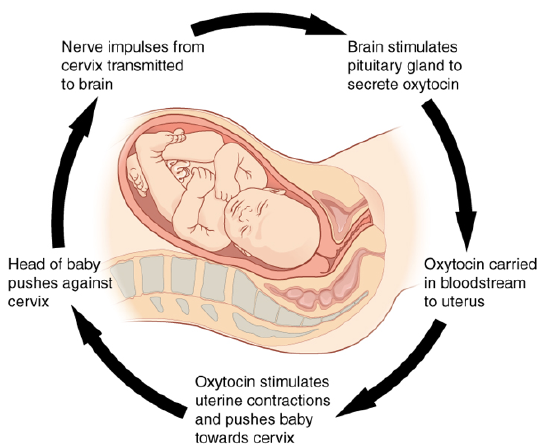
In a positive feedback loop, feedback serves to intensify a response until an endpoint is reached. Examples of processes controlled by positive feedback in the human body include blood clotting and childbirth.
Claret Clotting
When a wound causes bleeding, the body responds with a positive feedback loop to clot the claret and finish blood loss. Substances released past the injured blood vessel wall begin the process of blood clotting. Platelets in the blood start to cling to the injured site and release chemicals that attract additional platelets. As the platelets keep to amass, more of the chemicals are released and more than platelets are attracted to the site of the jell. The positive feedback accelerates the process of clotting until the clot is large enough to stop the bleeding.
Childbirth
Figure \(\PageIndex{4}\) shows the positive feedback loop that controls childbirth. The process normally begins when the head of the infant pushes against the cervix. This stimulates nerve impulses, which travel from the neck to the hypothalamus in the brain. In response, the hypothalamus sends the hormone oxytocin to the pituitary gland, which secretes information technology into the bloodstream so it tin be carried to the uterus. Oxytocin stimulates uterine contractions, which push the infant harder confronting the neck. In response, the neck starts to dilate in grooming for the passage of the baby. This bike of positive feedback continues, with increasing levels of oxytocin, stronger uterine contractions, and wider dilation of the cervix until the infant is pushed through the nativity canal and out of the body. At that signal, the cervix is no longer stimulated to send nerve impulses to the brain, and the unabridged procedure stops.
When Homeostasis Fails
Homeostatic mechanisms work continuously to maintain stable conditions in the human body. Sometimes, all the same, the mechanisms fail. When they practice, homeostatic imbalance may result, in which cells may not get everything they demand or toxic wastes may accrue in the torso. If homeostasis is non restored, the imbalance may lead to illness or even expiry. Diabetes is an example of a disease caused by homeostatic imbalance. In the case of diabetes, claret glucose levels are no longer regulated and may be dangerously high. Medical intervention tin can help restore homeostasis and possibly prevent permanent damage to the organism.
Diabetes is diagnosed in people who take abnormally high levels of claret glucose after fasting for at least 12 hours. A fasting level of blood glucose below 100 is normal. A level between 100 and 125 places you in the pre-diabetes category, and a level higher than 125 results in a diagnosis of diabetes.
Of the two types of diabetes, type two diabetes is the near common, bookkeeping for nigh 90 percent of all cases of diabetes in the U.s.. Type 2 diabetes typically starts after the age of twoscore. Even so, because of the dramatic increment in recent decades in obesity in younger people, the age at which type 2 diabetes is diagnosed has fallen. Fifty-fifty children are now being diagnosed with type ii diabetes. Today, almost 30 million Americans have blazon 2 diabetes, and some other 90 million have pre-diabetes.
You are probable to have your blood glucose level tested during a routine medical exam. If your blood glucose level indicates that you have diabetes, information technology may come every bit a shock to yous because y'all may not take whatever symptoms of the disease. You are not alone, because as many every bit one in four diabetics does not know they take the illness. Once the diagnosis of diabetes sinks in, you lot may be devastated by the news. Diabetes can pb to centre attacks, strokes, blindness, kidney failure, and loss of toes or feet. The risk of death in adults with diabetes is fifty percentage greater than information technology is in adults without diabetes, and diabetes is the seventh leading crusade of death in adults. In improver, controlling diabetes usually requires frequent blood glucose testing, watching what and when y'all eat and taking medications or even insulin injections. All of this may seem overwhelming.
The good news is that changing your lifestyle may terminate the progression of type 2 diabetes or even contrary information technology. Here's how:
- Lose weight. Any weight loss is beneficial. Losing as little equally 7 percent of your weight may exist all that is needed to terminate diabetes in its tracks. It is particularly of import to eliminate excess weight around your waist.
- Do regularly. You should endeavour to practice five days a week for at least 30 minutes. This will not only lower your blood saccharide and assistance your insulin work better; information technology will also lower your blood pressure and improve your heart wellness. Some other bonus of exercise is that it volition help you lose weight by increasing your basal metabolic rate.
- Prefer a salubrious diet. Decrease your consumption of refined carbohydrates such as sweets and sugary drinks. Increase your intake of fiber-rich foods such as fruits, vegetables, and whole grains. About a quarter of each repast should consist of high-poly peptide foods, such as fish, chicken, dairy products, legumes, or nuts.
- Control stress. Stress can increase your blood glucose and also raise your blood pressure and risk of heart disease. When y'all feel stressed out, do animate exercises or have a brisk walk or jog. As well, endeavour to supplant stressful thoughts with more calming ones.
- Institute a back up system. Enlist the help and support of loved ones likewise as medical professionals such every bit a nutritionist and diabetes educator. Having a support system will assist ensure that you are on the path to wellness and that you tin stick to your program.
Review
- What is homeostasis?
- Define the setpoint and normal range for physiological measures.
- Identify and define the four interacting components that maintain homeostasis in feedback loops.
- Compare and contrast negative and positive feedback loops.
- Explain how negative feedback controls body temperature.
- Requite two examples of physiological processes that are controlled by positive feedback loops.
- A negative feedback loop:
- brings a variable'southward level back to a normal range
- can lower, but not raise, body temperature
- is the type of feedback involved in claret clotting
- A and B
- During breastfeeding, the stimulus of the baby sucking on the nipple increases the amount of milk produced by the mother. The more sucking, the more milk is usually produced.
- Is this an example of negative or positive feedback? Explain your answer.
- What do y'all call up might be the evolutionary benefit of the milk production regulation machinery described in part a?
- Explain why homeostasis is regulated by negative feedback loops, rather than positive feedback loops.
- A setpoint is usually:
- the summit of a normal range
- the bottom of a normal range
- in the middle of a normal range
- the point at which changes tin no longer occur
- The level of a sex hormone, testosterone (T), is controlled by negative feedback. Another hormone, gonadotropin-releasing hormone (GnRH), is released by the hypothalamus of the encephalon, which triggers the pituitary gland to release luteinizing hormone (LH). LH stimulates the gonads to produce T. When at that place is likewise much T in the bloodstream, it feeds dorsum on the hypothalamus, causing information technology to produce less GnRH. While this does not describe all the feedback loops involved in regulating T, answer the following questions nigh this item feedback loop.
- What is the stimulus in this arrangement? Explain your answer.
- What is the control center in this arrangement? Explain your answer.
- What is the pituitary considered in this system: stimulus, sensor, control middle, or effector? Explicate your respond.
Explore More
smithworactagoine.blogspot.com
Source: https://bio.libretexts.org/Bookshelves/Human_Biology/Book:_Human_Biology_%28Wakim_and_Grewal%29/10:_Introduction_to_the_Human_Body/10.7:_Homeostasis_and_Feedback
0 Response to "Cbio Breaking Out Again With Steadier Volume"
Post a Comment