If You Dont Drink Milk Then Start Drinking Again
Why humans have evolved to drink milk

Humans didn't start out being able to digest beast milk – just now many populations do. Why has development favoured tolerating dairy?
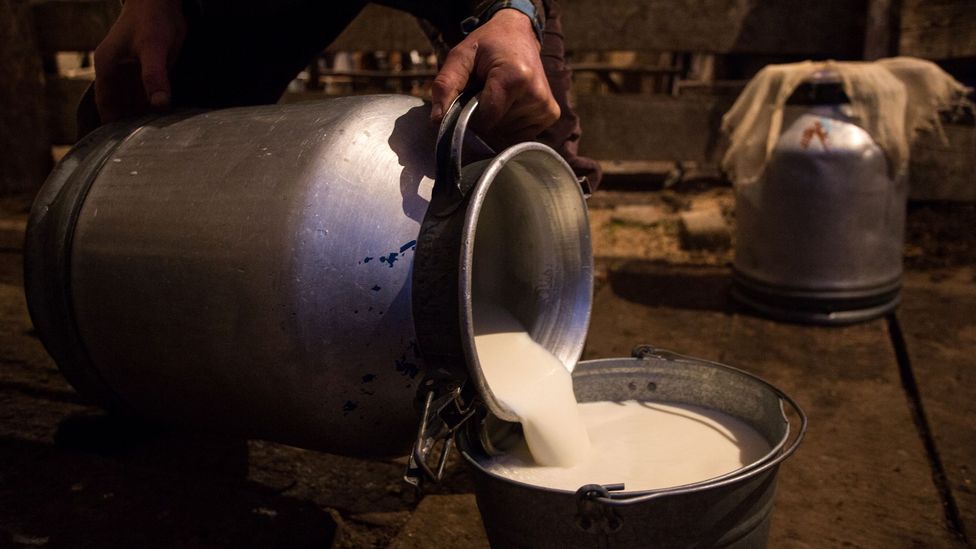
Milk is poured at a dairy farm in Russian federation. Compared to humanity'south 300,000-year history, drinking milk is a new habit (Credit: Getty)
Set up against the 300,000-year history of our species, drinking milk is quite a new habit. Earlier virtually 10,000 years agone or and so, hardly anybody drank milk, and and so merely on rare occasions. The showtime people to beverage milk regularly were early farmers and pastoralists in western Europe – some of the commencement humans to live with domesticated animals, including cows. Today, drinking milk is common practise in northern Europe, Northward America, and a patchwork of other places.
Baby food
At that place is a biological reason why drinking animal milk is odd.
Milk contains a type of sugar called lactose, which is singled-out from the sugars found in fruit and other sugariness foods. When nosotros are babies, our bodies make a special enzyme called lactase that allows united states of america to digest the lactose in our mother'south milk. But later on nosotros are weaned in early on childhood, for many people this stops. Without lactase, nosotros cannot properly assimilate the lactose in milk. As a consequence, if an developed drinks a lot of milk they may feel flatulence, painful cramps and fifty-fifty diarrhoea. (It's worth noting that in other mammals, at that place aren't whatsoever lactase-persistent adults – adult cows don't have active lactase, and neither practice cats or dogs, for instance).
And then the first Europeans who drank milk probably farted a lot equally a result. But and then development kicked in: some people began to keep their lactase enzymes agile into machismo. This "lactase persistence" allowed them to drink milk without side furnishings. It is the result of mutations in a department of DNA that controls the action of the lactase gene.
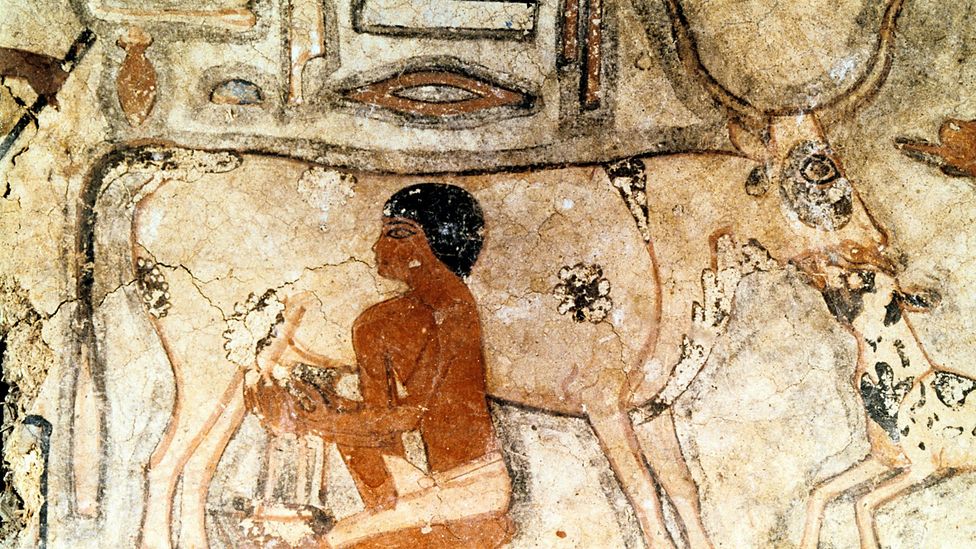
Artwork from the tomb of Methethi in Egypt, dated to around 2350BC, shows an ancient Egyptian milking a cow (Credit: Getty)
"The first fourth dimension that nosotros run into the lactase persistence allele in Europe arising is effectually v,000 years BP [before present] in southern Europe, and then it starts to kick in in central Europe around 3,000 years agone," says assistant professor Laure Ségurel at the Museum of Humankind in Paris, who co-authored a 2017 review of the science of lactase persistence.
The lactase persistence trait was favoured by evolution and today information technology is extremely common in some populations. In northern Europe, more xc% of people are lactase persistent. The aforementioned is true in a few populations in Africa and the Middle East.
Merely there are likewise many populations where lactase persistence is much rarer: many Africans do not have the trait and information technology is uncommon in Asia and South America.

A woman purchases soy milk in Hong Kong. Dairy can make many people experience sick in Asia, where the lactase persistence trait is uncommon (Credit: Getty)
It is hard to make sense of this blueprint because we don't know precisely why drinking milk, and therefore lactase persistence, was a good thing, says Ségurel: "Why was it and so strongly advantageous in itself?"
The obvious reply is that drinking milk gave people a new source of nutrients, reducing the chance of starvation. But on closer inspection this doesn't concur upward.
"At that place's a lot of different sources of food, so it'south surprising that one source of nutrient is so of import, so different from other sorts of nutrient," says Ségurel.
People who are lactase-non-persistent can still eat a certain amount of lactose without ill effects, and then drinking a small amount of milk is fine. There is also the option of processing milk into butter, yoghurt, cream or cheese – all of which reduce the amount of lactose. Hard cheeses like cheddar take less than 10% as much lactose every bit milk, and butter is similarly low. (Read more than about parmigiano, a cheese with so fiddling lactose it can exist eaten by the lactose-intolerant). "Heavy cream and butter have the lowest lactose," says Ségurel.
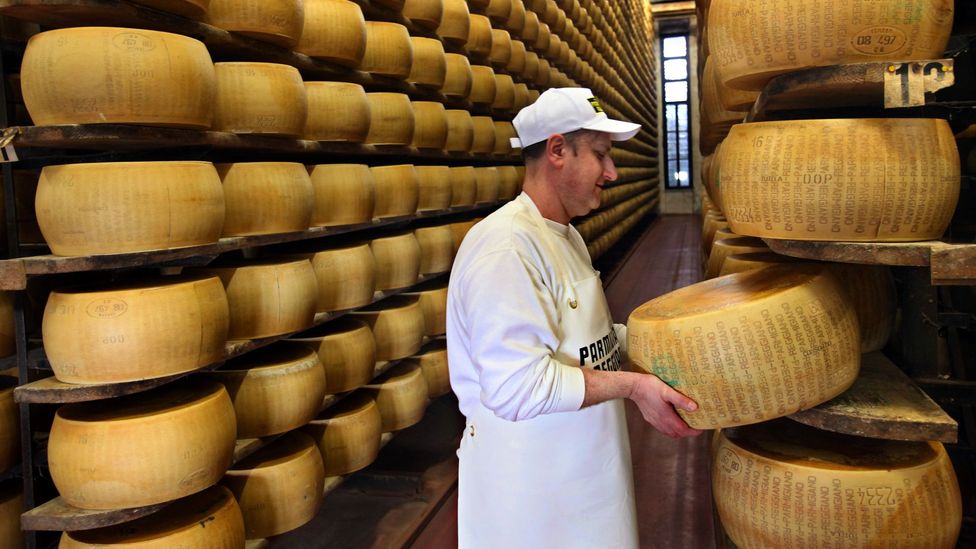
Hard cheeses like parmigiano-reggiano can have footling to no lactose (Credit: Getty)
Appropriately, people seem to have invented cheese rather quickly. In September 2018, archaeologists reporting finding fragments of pottery in what is now Croatia. They carried fatty acids, suggesting that the pottery had been used to dissever curds from whey: a crucial step in making cheese. If that is correct (and the estimation has been questioned), people were making cheese in southern Europe 7,200 years ago. Like evidence from slightly more recent times, merely still more than 6,000 years ago, has been found elsewhere in Europe. This is well before lactase persistence became common in Europeans.
That said, there is clearly a blueprint behind which populations evolved loftier levels of lactase persistence and which didn't, says genetics professor Dallas Swallow of University College London. Those with the trait are pastoralists: people who heighten livestock. Hunter-gatherers, who practice not proceed animals, did not acquire the mutations. Neither did "forest gardeners" who cultivated plants, but not livestock.
It makes sense that people who did not have admission to animal milk were non under peachy evolutionary pressure to conform to drinking information technology.
The question is, why did some pastoralist people acquire the trait and not others?
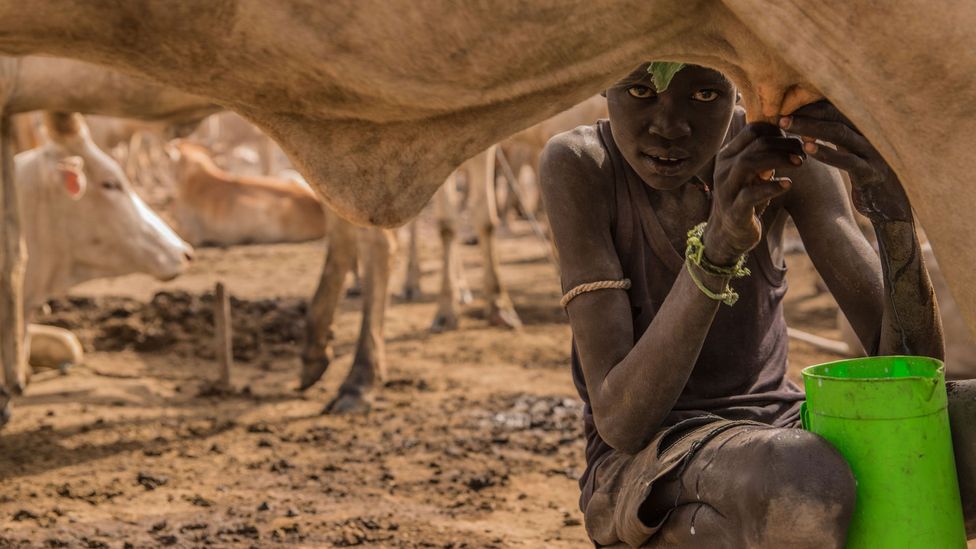
A Sudanese male child milks a cow at a cattle camp; an enduring mystery is why only some pastoralist groups acquired lactase persistence (Credit: Getty)
Ségurel points to east Asian herding peoples, such as those in Mongolia, who have some of the lowest rates of lactase persistence fifty-fifty though they rely heavily on milk from their animals for food. The mutations were common in nearby populations in Europe and southwest asia, then it would have been possible for them to spread into these eastward Asian groups, only they didn't. "That's the big puzzle," says Ségurel.
Dairy benefits
She speculates that drinking milk might have other advantages too its nutritional value. People who continue livestock are exposed to their diseases, which tin can include anthrax and cryptosporidiosis. It may be that drinking cow's milk provides antibodies against some of these infections. Indeed, milk's protective issue is idea to exist ane of the benefits of breastfeeding children.

Women nurse their children in Bogota, Colombia for a World Breastfeeding Calendar week event. Milk's protective effect is thought to be a benefit of breastfeeding (Credit: Getty)
But some of the mysterious absences of lactase-persistence could be down to sheer chance: whether anyone in a group of pastoralists happened to become the right mutation. Until adequately recently there were a lot fewer people on Earth and local populations were smaller, so some groups would miss out by obviously bad luck.
"I think the most coherent part of the picture is that there's a correlation with the way of life, with pastoralism," says Swallow. "Simply y'all take to have the mutation starting time." Merely then could natural selection become to work.
In the case of Mongolian herders, Swallow points out that they typically drinkable fermented milk, which once more has a lower lactose content. Arguably, the ease with which milk can be processed to exist more edible makes the rise of lactase persistence fifty-fifty more puzzling. "Because we were then good at adapting culturally to processing and fermenting the milk, I'm struggling with why we ever adapted genetically," says Swallow'southward PhD student Catherine Walker.
There may have been several factors promoting lactase persistence, not merely one. Swallow suspects that the fundamental may accept been milk'south nutritional benefits, such as that information technology is rich in fat, protein, saccharide and micronutrients like calcium and vitamin D.
It is also a source of clean water. Depending on where your community lived, you may have evolved to tolerate it for 1 reason over another.
It's unclear whether lactase persistence is still being actively favoured past development, and thus whether information technology will become more than widespread, says Eat. In 2018 she co-authored a study of a group of pastoralists in the Coquimbo region of Chile, who acquired the lactase-persistence mutation when their ancestors interbred with newly-arrived Europeans 500 years agone. The trait is now spreading through the population: it is existence favoured by development, every bit information technology was in northern Europeans 5,000 years ago.
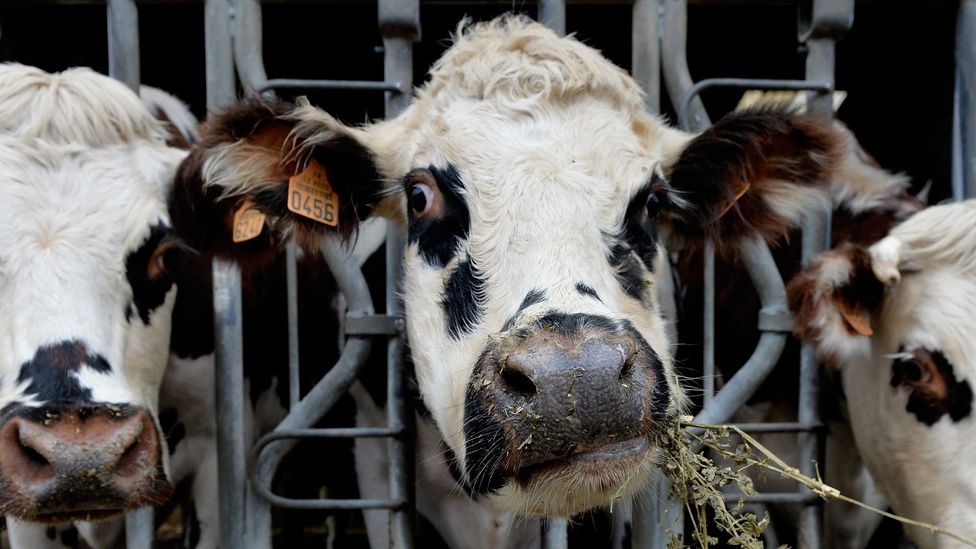
Dairy cows munch on alfalfa in northward-western French republic, a part of the globe where people would have adjusted to drinking milk around three,000 years agone (Credit: Getty)
But this is a special case because the Coquimbo people are heavily reliant on milk. Globally, the film is very different. "I would think it's stabilised myself, except in countries where they accept milk dependence and there is a shortage [of other food]," says Eat. "In the West, where we have such good diets, the selective pressures are non really likely to be there."
Dairy decline?
If anything, the news over the last few years offers the opposite impression: that people are abandoning milk. In Nov 2018, the Guardian published a story headlined "How we roughshod out of dearest with milk", describing the meteoric rise of the companies selling oat and nut milks, and suggesting that traditional milk is facing a major battle.
Simply the statistics tell a different story. According to the 2018 report of the IFCN Dairy Research Network, global milk product has increased every year since 1998 in response to growing demand. In 2017, 864 million tonnes of milk were produced worldwide. This shows no sign of slowing down: the IFCN expects milk demand to rise 35% past 2030 to 1,168 1000000 tonnes. (Read more than nigh how milk became a staple food in industrialised societies).
Notwithstanding, this masks some more localised trends. A 2010 study of food consumption institute that in the United states milk consumption has fallen over the last few decades – although it was replaced with fizzy drinks, not almond milk. This autumn was balanced past growing demand in developing countries, peculiarly in Asia – something the IFCN has also noted. Meanwhile, a 2015 study of people's drinking habits in 187 countries found that milk drinking was more common in older people, which does suggest that information technology is less popular with the immature – although this says nothing nigh young people's consumption of milk products like yoghurt.

While milk consumption has fallen in the United states of america, in Asia demand is growing (Credit: Getty)
Still, it seems unlikely that alternative milks volition brand much of a paring in the globe'southward growing appetite for milk, at least over the adjacent decade.
Walker adds that alternative milks are "not a like-for-like substitution" for creature milk. In detail, many don't have the aforementioned micronutrients. She says they are nigh useful for vegans and for people allergic to milk – the latter being a reaction to milk protein, and nothing to do with lactose.
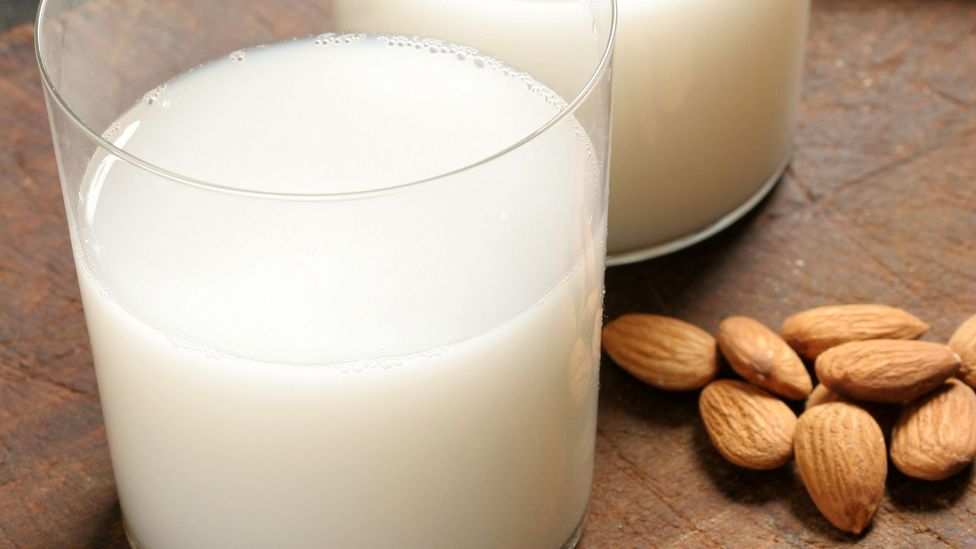
Culling milks like almond milk don't normally take the same micronutrients as dairy (Credit: Getty)
It'south particularly hit that so much of the growth in milk demand is in Asia, where near people are not-lactase-persistent. Whatever advantages the people at that place see in milk, they outweigh the potential digestive issues or the need to process the milk.
In fact, the United nations Food and Agriculture Organization has pushed for people in developing countries to keep more than not-traditional dairy animals, such every bit llamas, so that they tin obtain the benefits of milk fifty-fifty if moo-cow'south milk is unavailable or likewise expensive.
What's more than, a major study published in January described a "planetary health nutrition" that is designed to both maximise health and minimise our impact on the environment. While it entails drastically cutting down on red meat and other animal products, information technology nevertheless includes the equivalent of one glass of milk a day.
Milk, information technology seems, is non downward and out. If anything it's still on the upward – even if our bodies have mostly stopped evolving in response to it.
Join 900,000+ Time to come fans by liking usa on Facebook , or follow united states on Twitter or Instagram .
If you lot liked this story, sign up for the weekly bbc.com features newsletter , called "If Y'all Merely Read vi Things This Week". A handpicked selection of stories from BBC Future, Culture, Upper-case letter, and Travel, delivered to your inbox every Friday.
smithworactagoine.blogspot.com
Source: https://www.bbc.com/future/article/20190218-when-did-humans-start-drinking-cows-milk
0 Response to "If You Dont Drink Milk Then Start Drinking Again"
Post a Comment